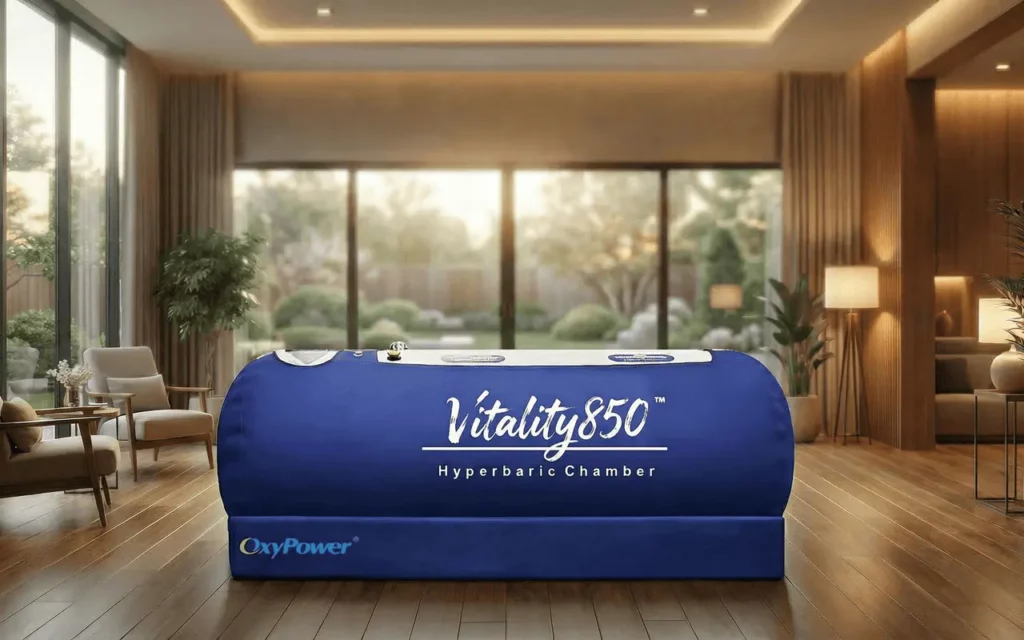

Mild HBOT at 1.3–1.5 ATA:
Why this pressure range is the wellness sweet spot
LeBron James spends over $1.5 million a year on body optimization — and HBOT is a fixture in that regimen. Bryan Johnson moved his office into his hyperbaric chamber. Kendall Jenner dedicated an entire room in her home to one. Here’s what none of the celebrity coverage mentions: they’re almost certainly not using the same high-pressure clinical chambers found in hospitals. The sweet spot for wellness and recovery — safe, accessible, and backed by the strongest emerging research — sits at a much more approachable pressure level: 1.3 to 1.5 ATA.
The pressure spectrum: not all HBOT is the same
Hyperbaric therapy is not a single treatment — it’s a spectrum defined by the pressure inside the chamber (measured in ATA, atmospheres absolute). The higher you go, the more oxygen dissolves into plasma — but the relationship isn’t linear, and more isn’t always better. At very high pressures, diminishing physiological returns arrive alongside meaningfully increased risks, equipment costs, and the need for medical supervision.
Figure 1: The HBOT pressure spectrum. 1.5 ATA balances physiological effect, safety, and everyday accessibility. 2.0 ATA and above is hospital-grade and requires physician supervision.
The 1.3–1.5 ATA range is where a different calculation emerges: enough pressure to cross meaningful biological thresholds, with a safety profile that supports accessible, routine use. That’s the sweet spot.
What the research says about 1.5 ATA
* 1.3 ATA and 1.5 ATA aren’t identical. At 1.3 ATA, plasma oxygen rises modestly — fine for general relaxation. At 1.5 ATA, the increase is more substantial and is the pressure most represented in brain health, inflammation, and longevity research. For specific wellness goals, 1.5 ATA is generally the more effective target.
Who is actually using mild HBOT?
Hard chamber vs. soft chamber: the practical choice
✓ Near-100% medical oxygen
✗ Large, expensive
✗ Requires professional staff
✗ Not suited for home use
✓ Practical footprint
✓ No clinical training needed
✓ Optional O2 concentrator
✓ Strong cost-to-benefit
✓ Reliable 1.5 ATA
✓ Durable for high-frequency use
✗ Higher cost
✗ Requires staff management
Note: when buying a soft chamber, verify the actual operating pressure. Cheap fabric-only construction often can’t reliably sustain 1.5 ATA — confirm the manufacturer’s pressure specifications before purchasing.


How to think about a protocol
What mild HBOT is not
Mild HBOT is not a replacement for medical treatment of serious conditions. FDA-approved indications involve clinical pressures of 2.0 ATA and above, administered under physician supervision — not home chambers. Claims circulating online — HBOT as a treatment for autism, cancer, or HIV — are not supported by sufficient clinical evidence. Harvard Health and the Cleveland Clinic both note that while HBOT has strong evidence for specific applications, some promoted claims require more rigorous validation.
What mild HBOT is supported for — recovery, inflammation reduction, cognitive support, cellular longevity, sleep quality, and athletic performance — is where it delivers real, evidence-backed value.
The bottom line
The question isn’t whether HBOT works — its clinical foundation is decades deep. The question is what pressure range works for your goals, and whether you need hospital-grade equipment to get there. For wellness, recovery, brain health, and longevity applications, the answer is increasingly clear: 1.3–1.5 ATA delivers meaningful, evidence-supported results in a format that’s safe, accessible, and practical for regular use.
That’s the sweet spot — and why mild HBOT is no longer just for elite athletes and biohackers. It’s becoming an evidence-informed component of a thoughtful wellness routine for anyone serious about how they recover, age, and perform.
← New to HBOT? Start with Part 1 — the science behind the chamber
Read part 1 →